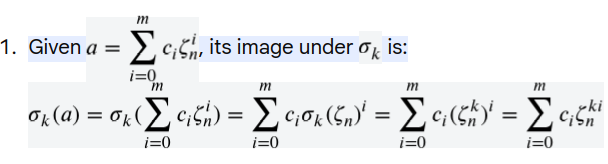
Hello everyone, I am having problem to understand Automorphism; particularly, how it acts on any ring element a \in Z_q/(X^m+1) , m=2^\nu a=c_0 + c_1 X + c_2 X^2 + … +c_{m-1} X^{m-1}
if so then the constant term remains in the same position after an automorphism. However when I applied Automorphism (to a ring element) using function implemented in OpehFHE library and saved it, its not the same. So I must have some gap in my understanding. Please help. Thanks for the reply in advance.
Thanks for the answer. However, when I saved a polynomial after computing an automorphism by \zeta^5 and compared it with that of the polynomial before the application of the automorphism, the constant term position also got changed; mathematically, it should remain in the same position. However, it also changes its position, which is why I am getting confused, and that’s why I have the question. Am I missing something?
How rotations are done over ciphertexts is determined by the encoding used. In most cases, we use the packed/batching method where the input vector (represented as coefficients of a polynomial) is first converted to the slot encoding (using an inverse FFT-like encoding). This slot encoding enables the actual (human-friendly) rotation functionality in CKKS, BGV, and BFV. In OpenFHE, the packed encoding for BGV/BFV is applied when calling MakePackedPlaintext, and for CKKS using MakeCKKSPackedEncoding. The code for the encoding logic can be examined at openfhe-development/src/pke/lib/encoding at v1.4.2 · openfheorg/openfhe-development · GitHub